Streamline Your Visual Strategy with Canva Mood Boards
Every successful creative project, whether it is a rebrand, a product launch, or a social media campaign, begins with a clear visual direction. Yet, many designers and entrepreneurs struggle to translate abstract ideas into a cohesive aesthetic. This is where a structured approach becomes invaluable. A well-crafted mood board serves as the foundational blueprint for your project's entire look and feel, acting as a central hub for inspiration, color palettes, typography choices, and textural elements. It moves you beyond scattered Pinterest pins and into a defined, actionable vision.
More Than Just Pretty Pictures: The Strategic Role of Visual Planning
Think of a mood board as a visual contract with yourself and your team. It ensures everyone is aligned on the direction before time and resources are invested in execution. For a small business owner, it can clarify the brand's personality—is it playful and bold, or minimalist and serene? For a graphic designer, it becomes a reference point to maintain consistency across dozens of deliverables. The goal is to create a single source of truth that captures the emotion, texture, and style you are aiming for.
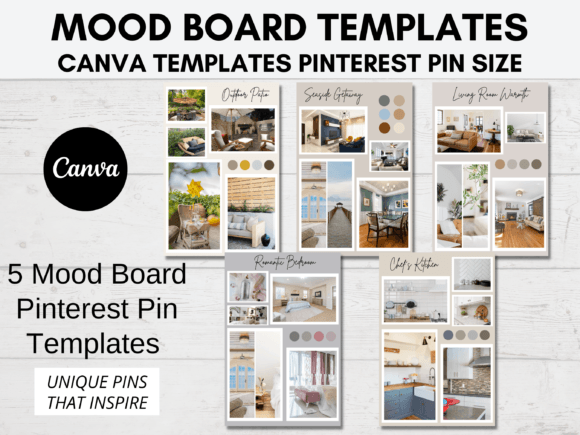
This is precisely why a dedicated Mood Board Template for Canva Pinterest is such a powerful asset. Instead of starting from a blank canvas, you begin with a professionally designed layout optimized for visual impact. These templates are built with a designer's eye for composition, ensuring your collected images, color swatches, and font samples are presented in a balanced and compelling way. The right template does the heavy lifting of arrangement, allowing you to focus purely on curation and creative direction.
Unlocking Efficiency and Professional Polish
The true value of a template lies in its ability to streamline your workflow. Consider the hours spent manually aligning images and text boxes in a design program. A pre-formatted template eliminates this friction. With a resource like the Mood Board Templates For Canva Pinterest – Instant Download, you gain immediate access to five distinct, editable layouts. Each offers a different compositional approach—one might feature a dominant central image with supporting details, while another could use a dynamic grid or overlapping elements. This variety allows you to choose the structure that best suits the story you need to tell.
Practical applications are vast and span nearly every creative field:
- Branding & Logo Design: Assemble core colors, potential logo sketches, and competitor analysis to define a unique identity.
- Web & UI Design: Map out the visual style for a website, including button styles, image treatments, and typographic hierarchy.
- Packaging & Product Design: Visualize materials, label aesthetics, and shelf presence before production begins.
- Social Media & Marketing: Plan the visual theme for a quarter's worth of Instagram posts or a Facebook ad campaign to ensure feed cohesion.
- Interior Design & Events: Coordinate fabrics, furniture, floral arrangements, and color schemes for weddings or styled shoots.
The process is designed for accessibility. You receive a PDF with a direct link to open the template in Canva—a free, user-friendly platform. This means you can edit on your computer or even on your phone via the Canva app. The included instructions guide you through swapping images, adjusting colors to match your brand's hex codes, and changing text to reflect your project's specific notes. It’s a hands-on way to learn while you create.
From Inspiration to Execution: A Practical Guide
Using the template effectively involves more than just dragging and dropping images. It requires thoughtful curation. Begin by gathering a wide range of inspiration—photographs, illustrations, textures, typography samples, and even color gradients. Then, use the template to refine this collection. Ask yourself: Does this image contribute to the core mood? Do these colors work together harmoniously? Is there a clear visual rhythm?
A key strength of these editable templates is the ability to customize every element. You can:
- Establish a Color Palette: Use the template's swatches to define your primary, secondary, and accent colors.
- Experiment with Typography: Test how different font pairings (e.g., a bold sans serif font for headlines with a clean serif font for body text) feel alongside your imagery.
- Incorporate Texture: Add subtle background textures or patterns to convey materiality.
- Add Contextual Notes: Use text boxes to annotate your choices—why a particular shade of blue was selected, or what feeling a certain pattern should evoke.
Once complete, your mood board becomes a powerful communication tool. Share it with clients for approval, with freelance contractors to guide their work, or use it internally to keep your own projects on track. The optimized 1000 x 1500 pixel size is perfect not only for Pinterest but also for sharing in presentations or on other social platforms like Instagram Stories.
Building a Cohesive Brand Ecosystem
Visual consistency is the bedrock of strong brand recognition. When a customer sees your Instagram post, your website header, and your product packaging, a unified aesthetic builds trust and professionalism. A mood board is the first step in creating that ecosystem. It allows you to see how different elements interact before they are applied to final assets.
This practice is invaluable for creating a suite of design assets. From social media graphics to editorial layouts for a blog, the mood board ensures everything feels connected. It helps you make intentional choices about display fonts for impact versus script fonts for elegance, or when to use a handwritten font for a personal touch. The template provides the canvas; your vision provides the content.
Ultimately, investing time in visual planning with a tool like a Canva mood board template saves countless hours of revision later. It reduces subjective feedback ("I don't like it") by grounding decisions in a pre-established visual language ("This aligns with our defined modern and clean aesthetic"). It transforms the creative process from one of guesswork to one of strategic execution, resulting in a more professional, polished, and effective final product.